
A new set of cushions is the cheapest way to make a fifteen-year-old sofa feel new again — new foam and fresh covers cost a fraction of a new sofa and keep the frame you already like. But a replacement lives or dies at the measuring stage. Half an inch of error shows up as a gap at the arms, a cushion you have to wrestle into place, or a zipper that never closes. The foam is the easy part. Here is the measuring method we use at the cutting bench, including the two shapes that trip people up: T-cushions and L-shaped corners.
Start with the best reference you have
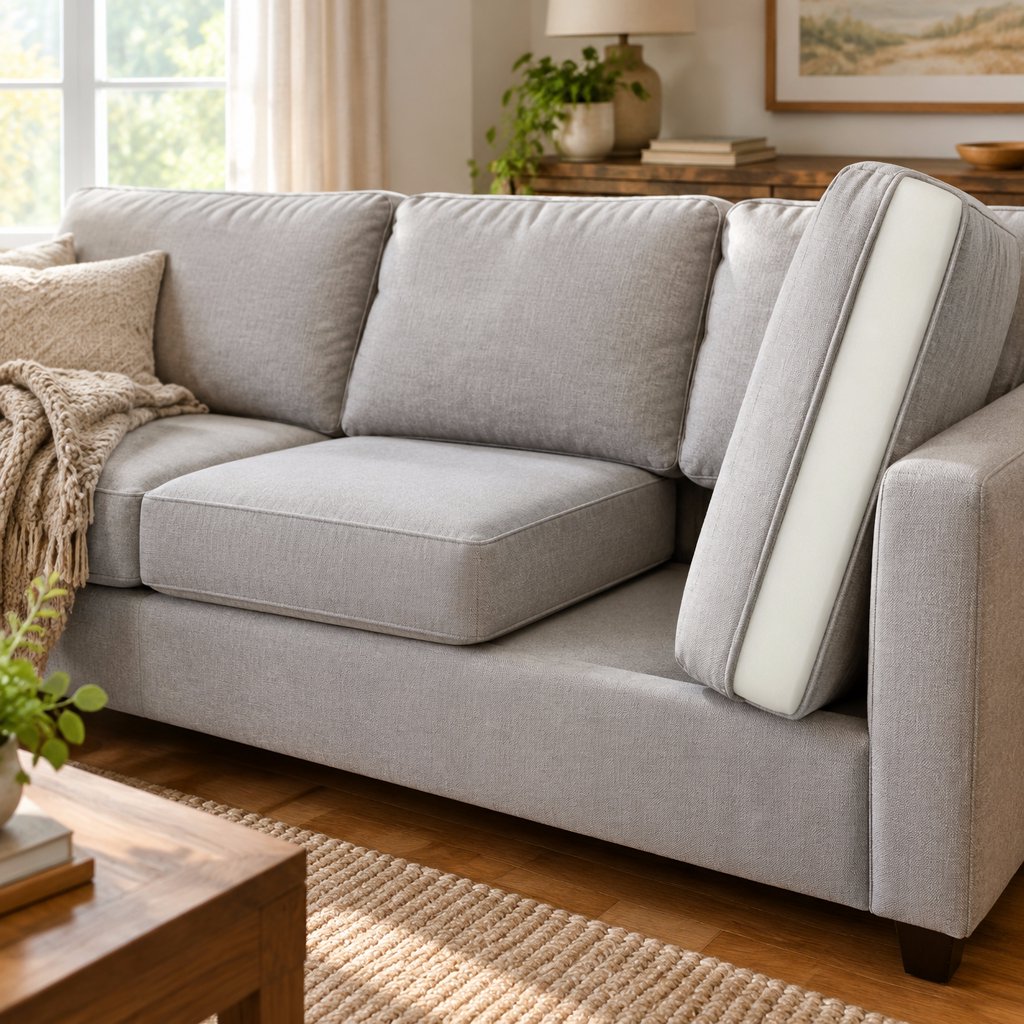
You have three possible sources of truth, in descending order of reliability. The old foam, out of its cover is best: unzip the cover, lift the foam out, lay it flat on a table, and measure width across the front, depth front to back, and thickness. The empty cover comes next — if the foam has sagged or crumbled, it can lie to you, but the cover keeps its shape. Unzip it fully, lay it flat on a table, smooth every panel, and measure panel to panel. The bare seat deck is the fallback for cushions that were never removable: measure the platform the cushion sits on, from seam to seam, and note anything that intrudes into the space.
Never measure a cushion while it is still on the sofa, squeezed between the arms with years of use behind it. Compressed foam reads thin at the edges and rounded at the corners, and you will copy its failure instead of replacing it.
Standard seats: three numbers
For a plain rectangular seat cushion you need width, depth, and thickness. Measure width and depth at the center of the cushion, not along a stretched or bulging edge, and work to the quarter inch — write down 24¼″, not "about two feet." For thickness, measure the old foam with nothing on top of it; a cushion that has carried people for a decade reads thinner than it was cut. Most sofa seats land between 4 and 6 inches thick. If the label of your old cushion said 5″, order 5″, even if the worn one now measures 4.3″.
T-cushions: the shape that wraps the arm
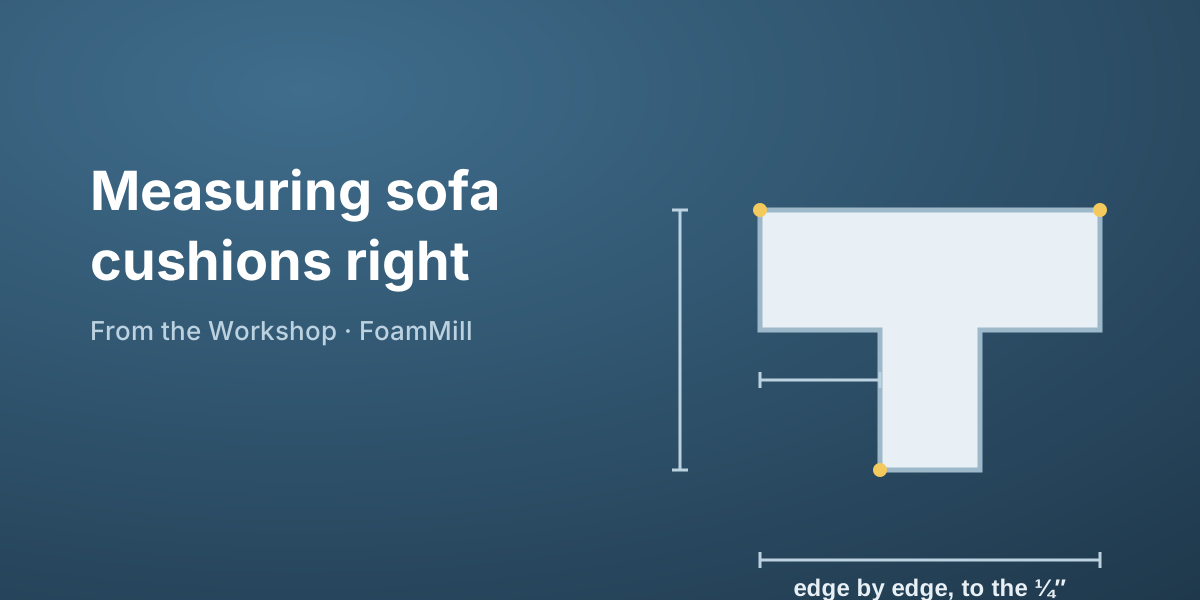
Look at many sofas from above and the seat cushions are not rectangles — the front corners extend forward and wrap around the armrests, making a T. That shape exists so the seat meets the arm all the way forward instead of leaving a gap beside your hip. It is also why one-size replacement cushions never look right on these sofas.
A T-cushion is a drawing exercise more than a measuring one. Sketch the outline on paper, then measure each straight edge to the quarter inch: the full-width back edge, the two shoulder edges that run alongside the arms, the depth of each shoulder, and the width and depth of the center stem. Eight numbers, and they have to agree with each other. Our T-cushion configurator takes the outline edge by edge, checks that the measurements close into a consistent shape, and flags conflicts before you order — which is exactly the mistake you want to catch at quoting time instead of at delivery time.
L-shaped corner cushions on sectionals
Sectional corners often share a single L-shaped cushion that wraps the corner in one piece. The method is the same: sketch the outline, then measure the inside and outside edges one at a time, including the depth of each leg of the L. One piece looks seamless and stays put; two straight cushions meeting at the corner are easier to flip and clean. Both are legitimate — just measure whichever way the sofa is actually built, not the way the catalog photographed it. The L-shape configurator prices either layout from edge measurements.
Thickness and firmness are two different dials
Match the old thickness unless the old thickness was genuinely wrong. If your knees sit above your hips when you settle into the sofa, the seat is too low — but the fix is usually one grade of firmer foam at the same thickness, not an extra inch of soft foam that will compress right back down. Sagging is mostly foam fatigue, and replacing tired foam with quality high-resilience foam at the original dimensions restores the seat height the frame was designed around.
Mistakes that cost a remake
- Measuring the top face of a sagged cushion instead of the foam or the flat cover.
- Rounding to the nearest inch. Cushions are cut to what you send; 24¾″ means 24¾″.
- Forgetting the arms on a T-cushion and ordering a rectangle that leaves two gaps.
- Measuring the cover while it is stretched over the old foam.
- Guessing thickness from memory instead of measuring the uncompressed foam.
The full method — marking tape points, tolerances, and shapes beyond the sofa — lives in our cushion measuring guide. Take your time with the tape, and the cutting is the easy part.