
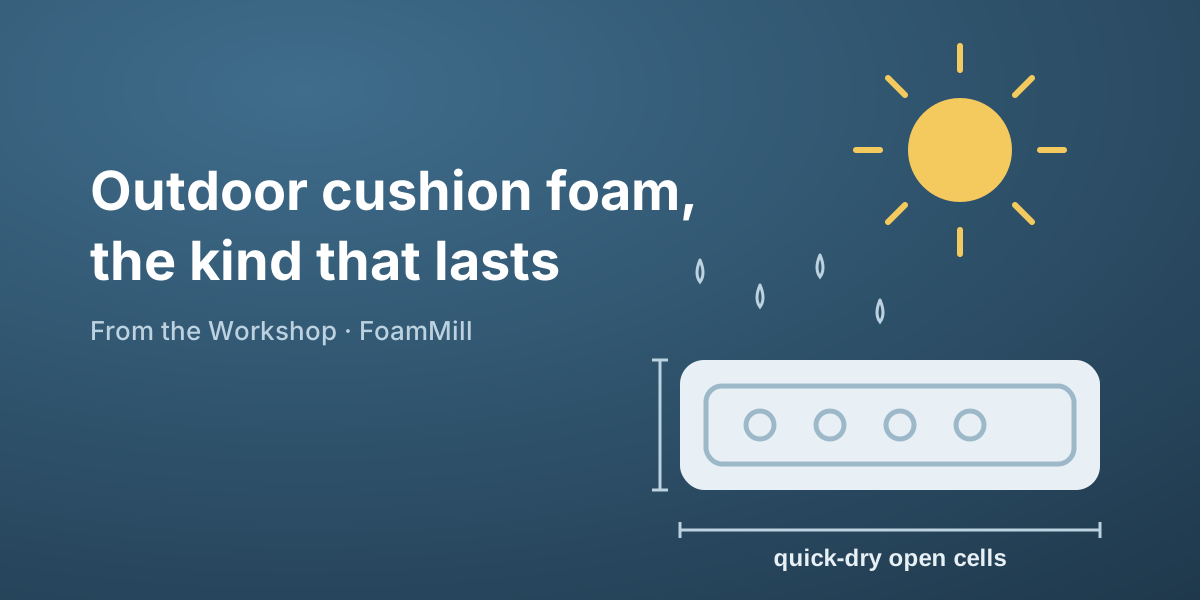
Every spring the same scene repeats on patios across the country: last year's cushions are flat, faded, and carrying a faint smell of last August's rain. The fabric usually gets the blame. It rarely is the fabric — outdoor cushions die from the inside out, and there are only two killers: ultraviolet light and trapped moisture. Choose foam that handles both, and the same set of cushions can look right for years instead of one season.
How outdoor foam actually fails
Standard upholstery foam is open-cell polyurethane. Left outdoors it fails in two ways. Sunlight breaks the polymer down — cushions left in direct sun slowly yellow, lose resilience and eventually crumble at the edges, even through the fabric cover. Water is the slower killer: ordinary foam soaks up rain like a sponge and holds it for days. Damp foam grows mildew, develops that musty basement smell, and compresses permanently once the cell structure collapses. Sitting on it, by comparison, barely matters.
The foam that survives outside
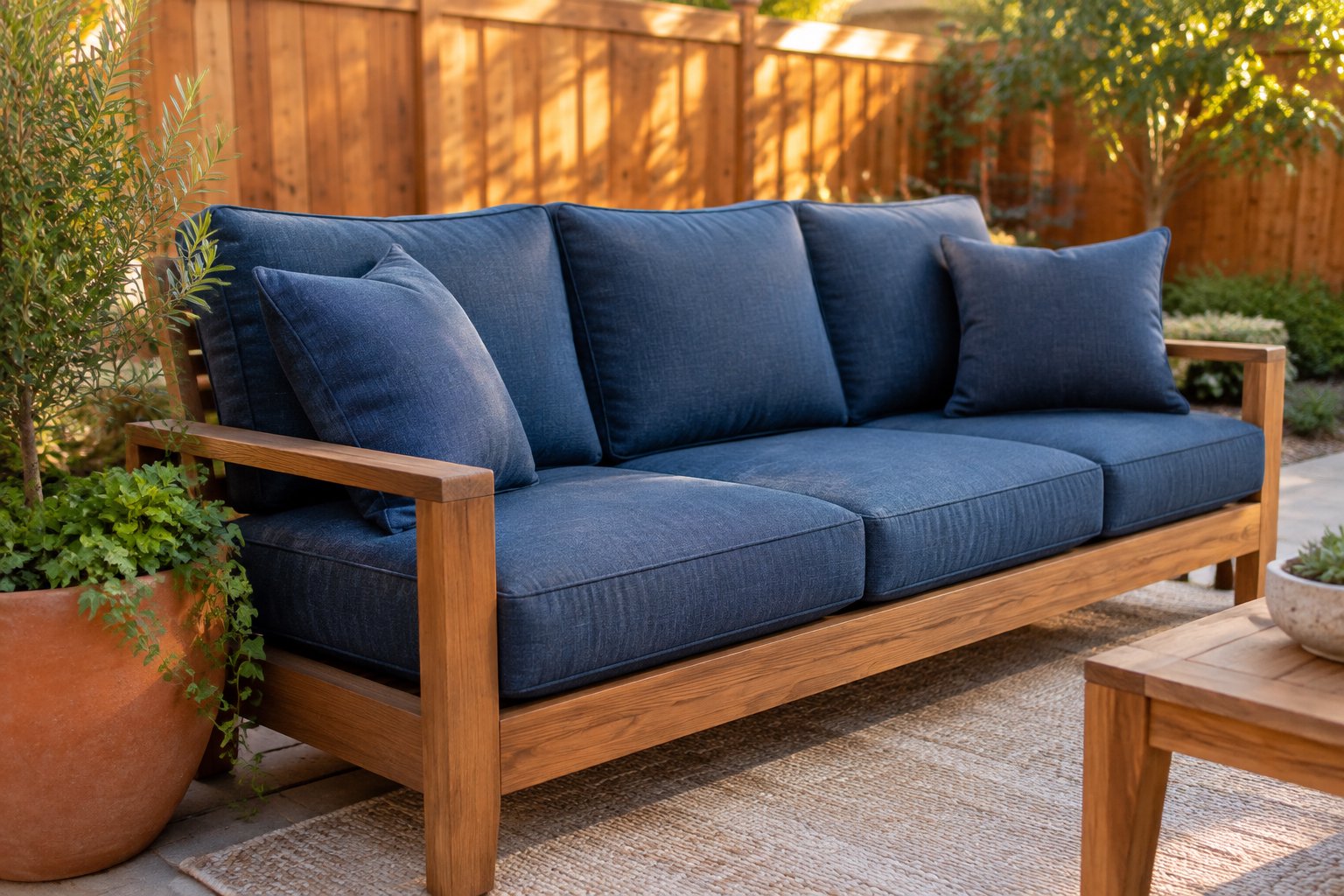
Quick-dry (reticulated) foam is the standard answer for cushions that genuinely live outside. The cells are large and fully open, so water drains straight through and the core air-dries in hours instead of days. The feel is slightly firmer and less plush than indoor foam — that is the trade for a cushion you never have to rescue. It is what we cut for deep-seat patio sets, sectionals and anything left exposed.
HD36-grade polyurethane is the budget-smart option for covered porches, screened-in rooms and cushions that come inside between uses. It is the same firm, long-lasting foam we use indoors; kept out of direct sun and rain, it performs identically.
Two fills to avoid outdoors: memory foam (dense, holds water, goes board-stiff in cold weather) and fiberfill-style fill for anything larger than a throw pillow (it clumps after the first wet cycle). Latex handles moisture well but is heavy and pricey — it earns its keep on marine applications more than patio sets.
Thickness that feels right
- Deep-seat patio chairs and sectionals: 4–5″ of foam, the same as an indoor sofa cushion.
- Standard chair seats: 3–4″; below 3″ you will bottom out on hard frame chairs.
- Back cushions: 3–4″, one grade softer than the seat so they give instead of pushing you forward.
- Outdoor dining and bench seats: 2.5–3″, on the firmer side so people can actually eat.
Fabric matters as much as foam
Solution-dyed acrylic — the Sunbrella-style canvas — is the gold standard: the color runs through the fiber, so UV fades it years later instead of months. Water-resistant rather than waterproof, which is exactly what you want: rain sheds off, vapor escapes. Cheaper polyester and olefin blends are fine for shaded, covered spaces. Whatever the fabric, make sure the construction breathes: zippered covers and a ventilated underside let the foam dry out. And skip the Dacron wrap — it is an indoor luxury trick that holds moisture against the foam outside.
Details that add seasons
- Zippers and removable covers, so a soaked cushion can be opened up and dried fast.
- Ties or hook-and-loop tabs on seat cushions — wind is the reason patio cushions "walk" off the deck.
- Storage or a cover in the off-season. UV does most of its damage cumulatively; six months under a deck bench halves a cushion's life for no reason.
- Dry them on edge. After heavy rain, stand cushions on their side so water drains out of the core instead of pooling under the fabric.
Replacing worn cushions: measure the frame, not the old foam
Old outdoor foam is compressed, warped and rounded at the edges — copying it copies the failure. Measure the seat frame or the inside of the cover at its widest points, working to a quarter inch; our measuring guide walks through the method. If you are unsure which fill suits your climate and exposure, the foam selection guide compares density and firmness by application. Sectionals and L-shaped runs price as single cuts, so odd shapes are not a problem.
Outdoor cushions are one of the few purchases where the upgrade from "fine this year" to "good for years" costs almost nothing at ordering time — it is one line on the quote, not a different project.