
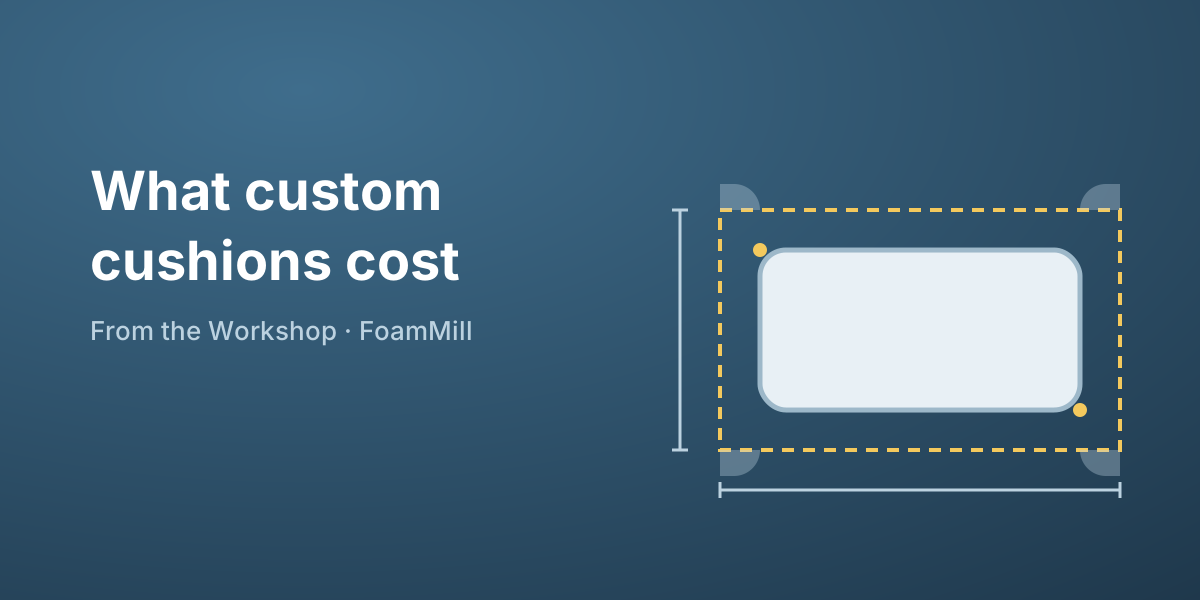
Ask what a custom cushion costs and most sellers answer with a phone call. That vagueness is hiding something — usually a markup on the easy parts. Custom cushion pricing is actually one of the most legible numbers in furniture, because the cost is mostly geometry and material: how much floor the shape covers, how thick it is, and what goes into it. Here is how the math works at our cutting bench, so you can read any quote — ours or anyone else's — and know exactly what you are paying for.
Price starts with the smallest rectangle
Foam comes in large rectangular blocks, and every shape is cut out of one. So pricing starts from the smallest rectangle the shape occupies — its bounding box — not from the area of the cushion itself. A perfect 24 by 24 inch seat uses its rectangle fully. A trapezoid or a diagonal-cut corner shape inside that same rectangle leaves offcuts on the cutting table, and those offcuts are priced in. This is also why a diagonal shape can cost noticeably more than a straight-sided one of similar size: you are paying for the rectangle it has to come out of, because the scrap cannot be un-cut.
Practical upshot: keep shapes square where you can. A rectangle with rounded corners prices like the rectangle it mostly is; an aggressive diagonal does not. Round shapes work the same way — a circle bills from the square it is cut out of, which is why a 30-inch round seat pad prices the same as a 30-inch square one, even though it uses less of the sheet.
Thickness is folded into the rate
Every thickness has its own price per square meter — a 5-inch cushion's rate already carries the extra material, so there is no separate "thickness fee" and no guessing how a 6-inch order will land. Rates do not climb in a straight line with thickness, either: the jump from 3 to 5 inches is steeper than 5 to 6, because the cutting and the foam grade structure do not scale linearly. The configurator shows the exact number for whatever thickness you pick, which beats the old furniture-store method of rounding everything to "good, better, best" and hoping you never ask what changed.
The two dials you actually control
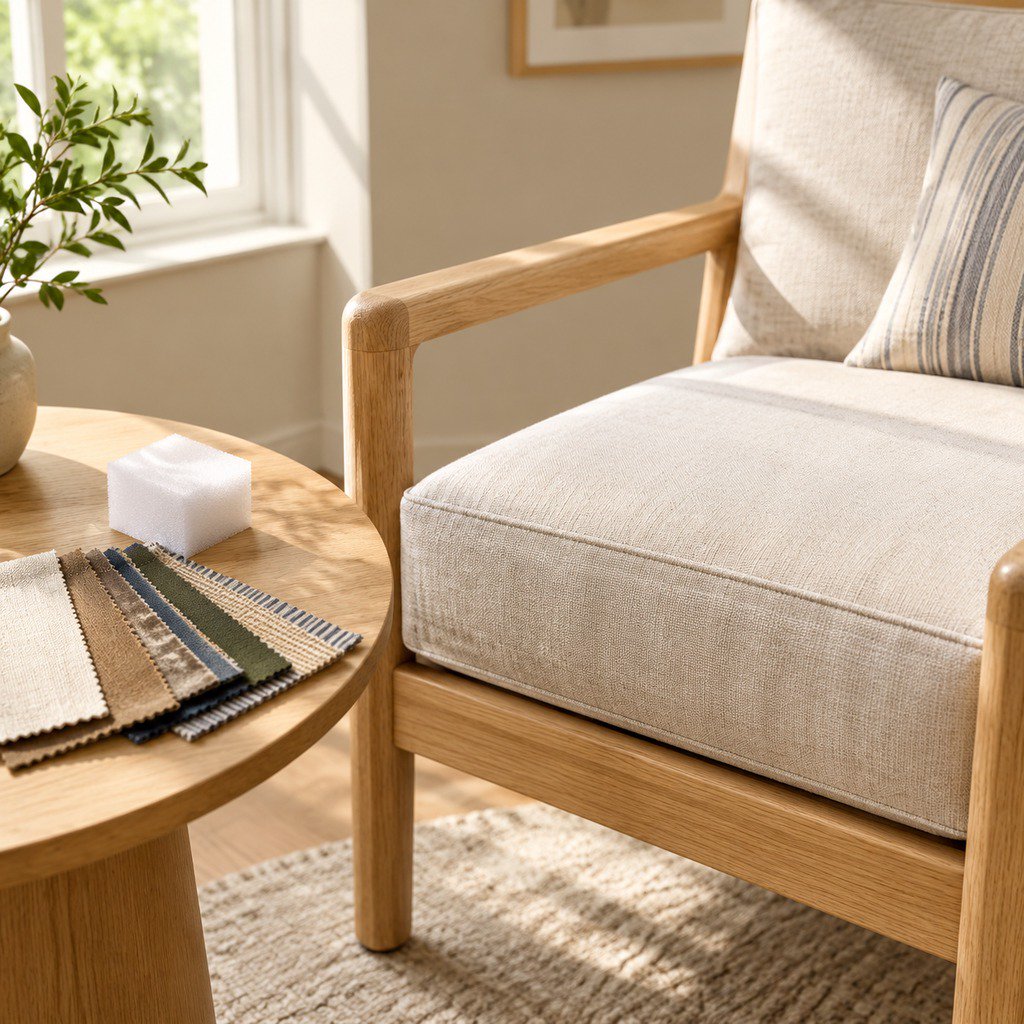
After size and thickness, the price moves with exactly two choices. Foam grade: high-resilience grades cost more per square meter than basic polyurethane, and the premium buys lifespan — the density and firmness guide covers why that trade pays for itself on any cushion that gets daily use. Fabric: families are priced differently, a performance weave costs less than embroidered velvet, and going fabric-free (foam only, for inserts and hidden cores) drops that line entirely. Add-ons — ties, non-skid bottoms, cord trim — price as flat per-cushion additions, each visible as its own line, never smuggled into the base rate.
Reading a quote the way the shop reads it
A transparent quote breaks into three parts you can verify with a tape measure and a calculator: the cushion's billed area in square meters (length times width of that bounding rectangle, converted), the per-square-meter rate for your thickness-plus-fabric combination, and the flat add-ons. Multiply the first two, add the third, and you have the total — no "design fee," no surprise at checkout. If a quote cannot be re-derived that way, the opacity is the product.
Where custom beats stock outright
- In-between sizes: a 23½-inch seat costs the same effort to cut as a 24-inch one. Stock sizing punishes you for the half inch; custom does not see it.
- Odd shapes: T-cushions, L-corners, trapezoids and circles are all just rectangles-with-scrap to the cutter. The premium over a plain rectangle is smaller than most people expect — and infinitely smaller than a gap that shows.
- Replacements: new foam in the covers you already own skips the most expensive material of all — new upholstery.
Measure the seat (the measuring guide shows the method), pick the grade and fabric, and the cushion configurator will show you the whole math — every line of it — before you decide. That is what a quote should look like, and it is the shortest path to knowing whether that living room refresh costs one cushion or one sofa.