
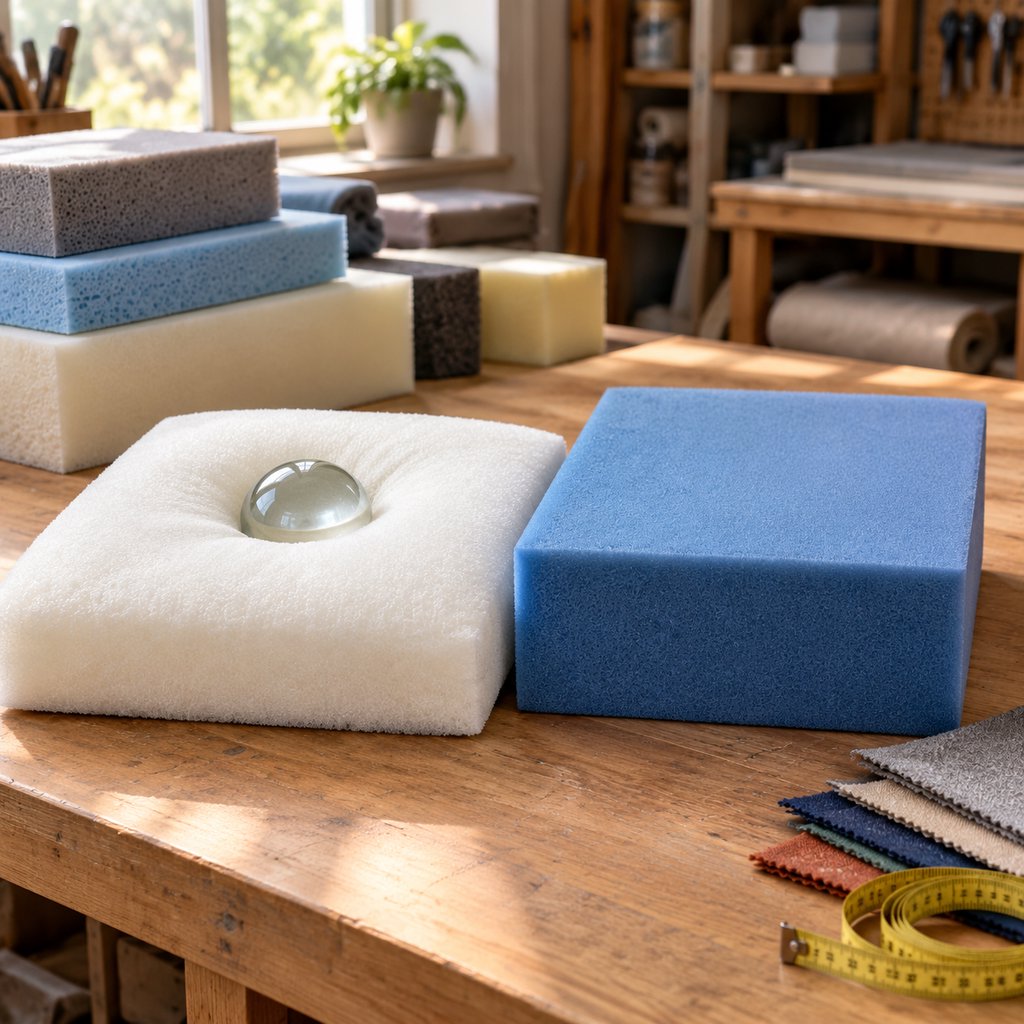
Two cushions can be cut to the exact same size and feel like they came from different planets. One swallows you like a pillow; the other feels like sitting on a kitchen counter. The difference is not thickness, and it is not quality — it is the combination of density and firmness, two separate measurements that get mixed up constantly, even by people who sell cushions for a living. Understanding what each one controls is the difference between ordering a cushion that feels right for a decade and one that feels wrong by spring.
Density is how much foam is in the foam
Density measures the weight of material packed into a given volume — in our grades, kilograms per cubic meter. An HD36 foam weighs 36 kilograms per cubic meter; an HR45 weighs 45. Nothing in that number tells you whether the cushion feels hard or soft. It tells you how much raw material is in every cubic inch, and that governs the one thing that matters most over time: durability. Denser foam has more cell walls to carry the load, so it resists fatigue, springs back after years of daily sitting, and holds its shape long after cheaper foam has developed a body-shaped crater.
A useful mental model: density is the foam's muscle. More muscle does not change how the cushion greets you on day one — it changes how it greets you in year five.
Firmness is the first five seconds
Firmness (the industry measures it as ILD — the force needed to compress the foam to a quarter of its thickness) is the initial feel. Low ILD foam yields the moment you sit down; high ILD foam pushes back. Two foams with identical density can be made at very different firmness grades, which is why "high density" and "rock hard" are not synonyms. A quality high-resilience foam can be poured soft and still outlast a cheap firm one by years.
This is also why the discount-store experience misleads people. Budget cushions often pair low density with high firmness: they feel supportive on the showroom floor because they are hard, then collapse within a season because there was never much material in them. Firmness you feel immediately; density you feel later.
How each one ages
Firmness softens first. Every foam loses a fraction of its ILD in the first weeks of use as the cell structure breaks in — which is exactly why a brand-new firm dining cushion can feel perfect two months in. That settling is normal and is worth allowing for: if a seat must end up medium, it often starts one grade firmer.
Density determines what happens after the break-in. Low-density foam keeps compressing a little more every month — the sag you see in a three-year-old sofa cushion is fatigue, not dirt. High-density foam loses far less over the same years, which is why we cut daily-use seats from HD36 and up, and step to HR45 for applications that never get a day off, like RV mattresses and restaurant seating.
Picking the combination by job
- Sofa and deep-seat cushions: mid-to-high density (HD36 or better), medium firmness. Daily use rewards material, not hardness.
- Window seats and reading nooks: the same density, one grade softer, usually 3 inches thick — lounging depth matters more than push-back.
- Dining and bench seats: firmer grades so people can sit at the table for a whole meal without sinking; 2.5–3 inches is plenty.
- Back cushions: one grade softer than the seat they accompany — they should give, not prop.
- RV, marine and commercial seats: HR-grade density. These cushions work every day and get replaced by professionals when they fail; material wins outright.
The one rule that ties it together
Thickness fixes nothing that density and firmness got wrong. A too-soft cushion made thicker is still a too-soft cushion — it just sags more slowly, and it changes your seating height while it does. Support comes from the right firmness carried by enough material, cut to the measurements the frame actually has. If you are replacing cushions, start from the tape measure (our sofa cushion measuring guide covers standard seats and T-cushions), then choose the feel (the foam selection guide walks each grade by application).
When you know the size and the feel you are after, the cushion configurator prices any combination of dimensions, thickness and foam grade to the quarter inch — so the trade-offs stay visible instead of hidden inside a fixed price.