
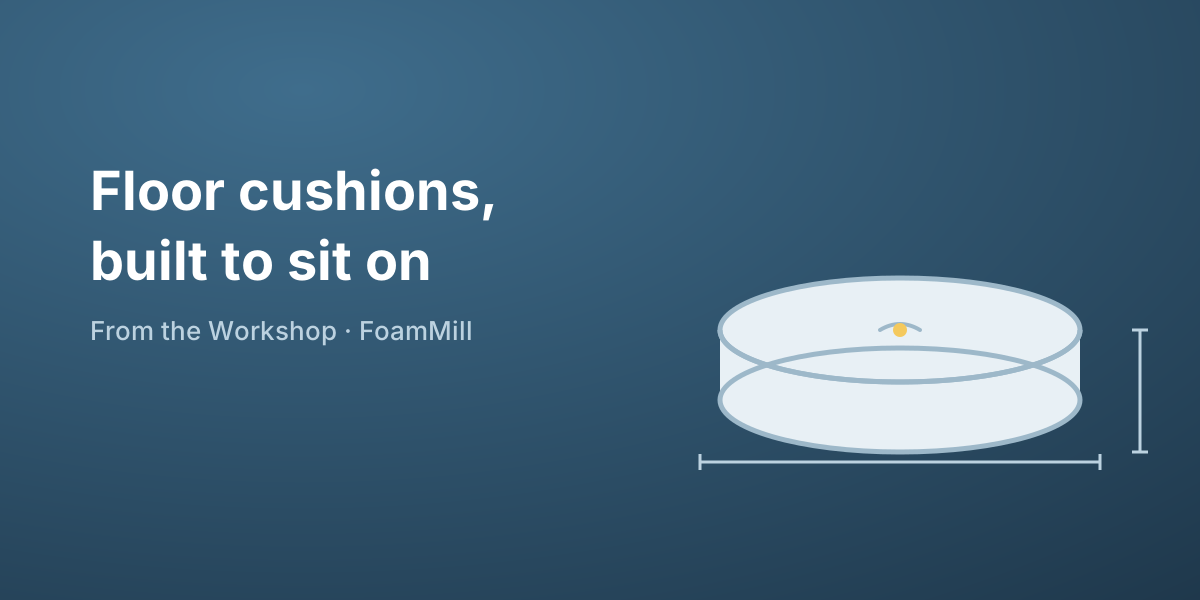
Floor sitting came back the long way — meditation corners, low coffee tables, gaming dens, reading nooks without chairs. And almost every disappointing floor cushion fails for the same three reasons: it is too flat, it is too soft, and its cover is decorative fluff that bottoms out the first week. A floor cushion you will actually sit on every day is a furniture decision, and it starts with three numbers: height, firmness, and a cover you can wash.

Height decides everything
The single most important number is how tall the cushion is, because sitting on the floor is a geometry problem: your sitting bones need to end up higher than your knees, or your pelvis tips backward, your lower back rounds, and your legs fall asleep halfway through the podcast. For most adults sitting cross-legged, that means a cushion 4 to 6 inches tall — classic meditation zafus land right in that range. Lounge-style floor cushions for leaning against a low table run taller and softer, 6 to 8 inches, because you are slouching on purpose.
Body proportions move the target: taller sitters and anyone with tight hips want the higher end or a second cushion under the ankles. The honest way to find your number is to sit on a stack of books wrapped in a towel for a week and measure the stack that stops your feet from tingling.
Firmness: support that does not quietly disappear
Floor cushions work harder than sofa cushions — there is no suspension between you and the floor, so the fill carries everything. Soft, fluffy, fiber-filled floor pillows feel welcoming for a week and then flatten into a pancake: fiber has no memory, it clumps, and once it compresses there is nothing pushing back. A floor cushion for daily sitting wants a firm, high-resilience foam core — the same foam logic as any daily-use seat, just taller relative to its width so the edges can yield a little while the middle holds.
The kneel test is the honest check: kneel on the cushion with your full weight. A real sitting core barely bottoms out; a decorative one is flat to the floor.
Fill options, honestly compared
- High-resilience foam core: the real answer for daily sitters. Holds height for years, keeps a defined shape, and pairs with a removable washable cover.
- Buckwheat hulls: the traditional meditation fill — molds beautifully to the body and stays cool, but it is heavy, rustles with every shift, and cannot be washed.
- Fiberfill: cheapest and softest; fine for the cushion nobody sits on daily. It clumps and flattens exactly when you started liking it.
The quiet advantage of the foam-core route is the separation of jobs: the core is the furniture, the cover is the laundry. Which brings us to —
The cover is half the purchase
Floor cushions live on the floor: dust, feet, spills, the dog. A cover in heavy cotton canvas or linen with a zipper comes off and goes in the wash; anything sewn shut is a decoration that ages badly. Two more cover details matter on hard floors: a non-skid bottom (the same grip logic as any sliding cushion — our anti-slide guide covers the full toolbox), and rounded, well-filled edges so the cushion reads as a seat rather than a deflated bag.
Shapes: round, square, or rectangle for two
- Round, 14–18 inches across: the classic meditation shape. Round corners never dig into thighs, and the circle encourages the cross-legged posture the height was chosen for.
- Square, 18–20 inches: the lounge shape — shoulders fit, it doubles as a floor seat at a low table, and squares stack into guest seating.
- Rectangle, bench-style: two sitters or side-by-side kids; pair two along a wall with lumbar support behind and you have reading-nook seating with no chairs at all. Height and thickness logic carry straight over from our bench cushion guide.
One refinement worth knowing: cushion pairs benefit from different firmness — a firmer seat below and a slightly softer pad on top gives you the support-below, comfort-above layering that works for every other cushion in the house. However you stack it, the core should be cut foam to your numbers — the cushion configurator prices any dimensions in seconds, and the cover is the part you get to have fun with.