
Boat cushions die of three things at once: sun from above, salt spray from every side, and water that has nowhere to go. A cockpit cushion that would last a decade in a living room can be brittle, musty and falling apart at the seams after one season on the water. Marine cushions are specified differently from the foam out — and knowing which layer fails first tells you exactly what to shop for.
The environment: UV, salt and standing water
Ultraviolet light is the number-one killer — the same breakdown we covered in our outdoor foam guide, but worse: on the water there is no shade structure, and the sun arrives twice, directly and reflected off the surface. Salt is the quieter attacker. It dries into crystals that abrade fabric every time someone shifts weight, and it is hygroscopic — salt residue pulls moisture out of the air and holds it against whatever is underneath. Add bilge humidity and rain pooling in a cockpit, and a cushion sits wet far more often than it sits dry.
Foam: match the fill to where the cushion lives
There is no single "marine foam" — there are three fills, each right for a different job. Quick-dry reticulated foam (the same open-cell construction used for patio deep seats) is the standard for cockpit seating: water passes through it instead of pooling, and it air-dries in hours. Closed-cell foam absorbs nothing at all — firm, floatable and hose-friendly, which makes it right for deck pads, kneeling pads and anywhere a cushion lives in the splash zone rather than under someone. Latex and high-resilience urethane belong below deck, in V-berth mattresses and settee cushions that get covered before the rain does; the foam selection guide walks the trade-offs. What has no place on a boat is plain furniture-grade foam: it soaks like a sponge, dries in days, and grows its own ecosystem in the meantime.
Fabric: vinyl or acrylic, and know which is which
Marine vinyl wipes clean, shrugs off spray and costs less — the right call for helm seats, bolsters and anything kids drag across with wet swimsuits. Its weakness is breathability: vinyl on a hot afternoon is a sauna, so it wants ventilation somewhere in the construction. Solution-dyed acrylic canvas (the Sunbrella family) breathes, keeps its color for years of direct sun and handles scrubbing — the standard for seating and backrest cushions. Many good builds combine them: acrylic where people sit, vinyl where feet and coolers land.
Construction details that matter on the water
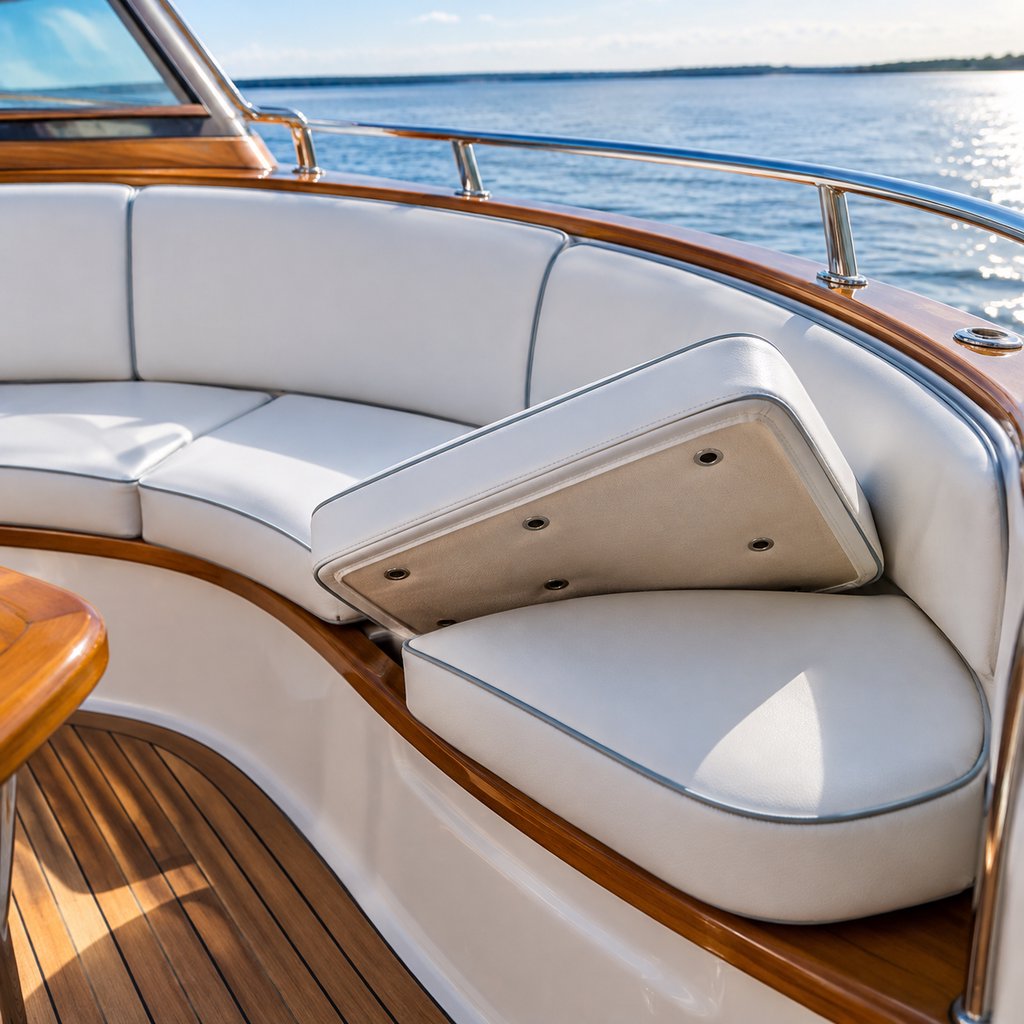
- Drainage: grommets or mesh vents under seat cushions so trapped water exits instead of souring the foam — the single highest-value detail in a wet cockpit.
- Plastic zippers only: metal zippers and salt water rust into one season of use; nylon tooth zippers with plastic pulls keep working.
- Quick-release fasteners: cushions that come off in seconds get taken off before storms and dried at home — which is most of what "maintenance" means on the water.
- Rounded corners and piping: rounded corners resist catching on rails and door frames; piping looks sharp but only belongs where hands, not hardware, will run over it.
Fit matters more on a boat than anywhere else
Boat settees, helm pods and V-berths are the least rectangular furniture in America. Curved settee corners, angled bulkheads and wheel wells mean stock cushions gap, rock and chafe — and a gapping cushion on a heeling boat is a trip hazard, not an eyesore. Measure each surface edge to edge, note every angle, and treat curved sections as custom cuts; the measuring guide covers the method, and curved runs price from their bounding shape like any other cut.
Winter is half the lifespan
More marine cushions are killed in storage than in service. Cushions left aboard over a damp winter spend six months as a compressed sponge. Pull them in the fall, stand them on edge to dry fully, and store them where air moves. That one habit, plus drainage vents and the right fabric, is the difference between cushions that look new in year five and a re-upholstery project in year two.
When you are ready to spec a set — cockpit seating, deck pads, a V-berth mattress — the boat cushions page shows the marine-grade combinations we cut, and any curved or odd shape prices from your measurements in seconds.