
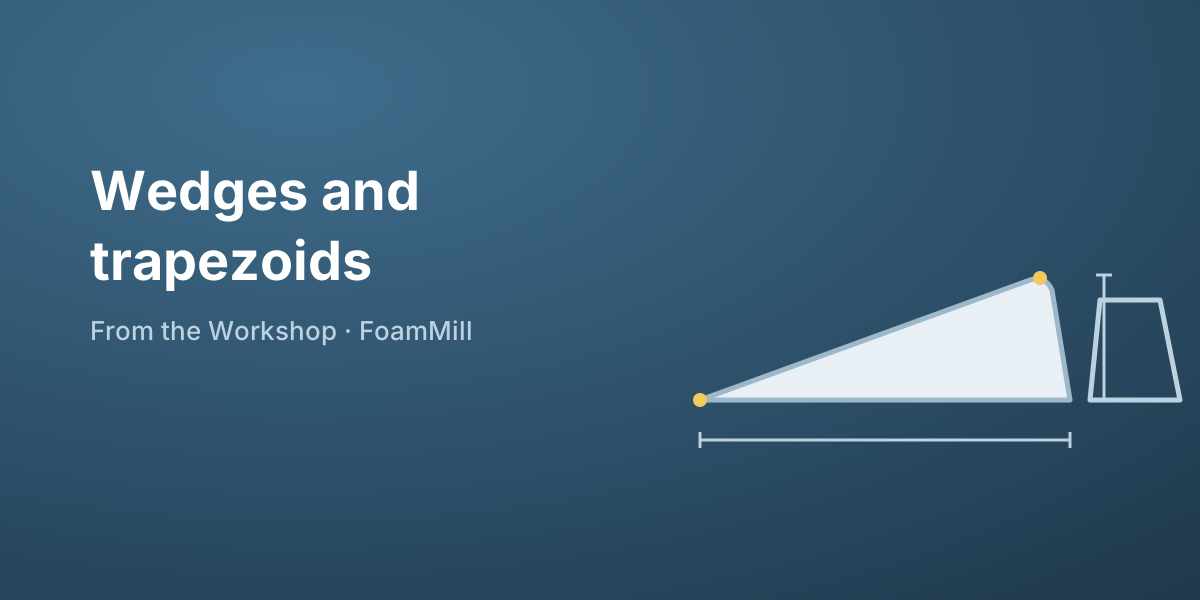
Flat rectangles cover most cushion work, but two non-rectangle shapes keep showing up on the cutting table because nothing rectangular does their job: the wedge (an inclined plane, high at one end and tapering to nothing) and the trapezoid (a run whose two parallel edges differ in width). Both look exotic and both are, mechanically, the simplest things we cut. Here is where each earns its keep, how to measure for one, and the one pricing fact worth knowing before you order.
The wedge: an inclined plane doing quiet work
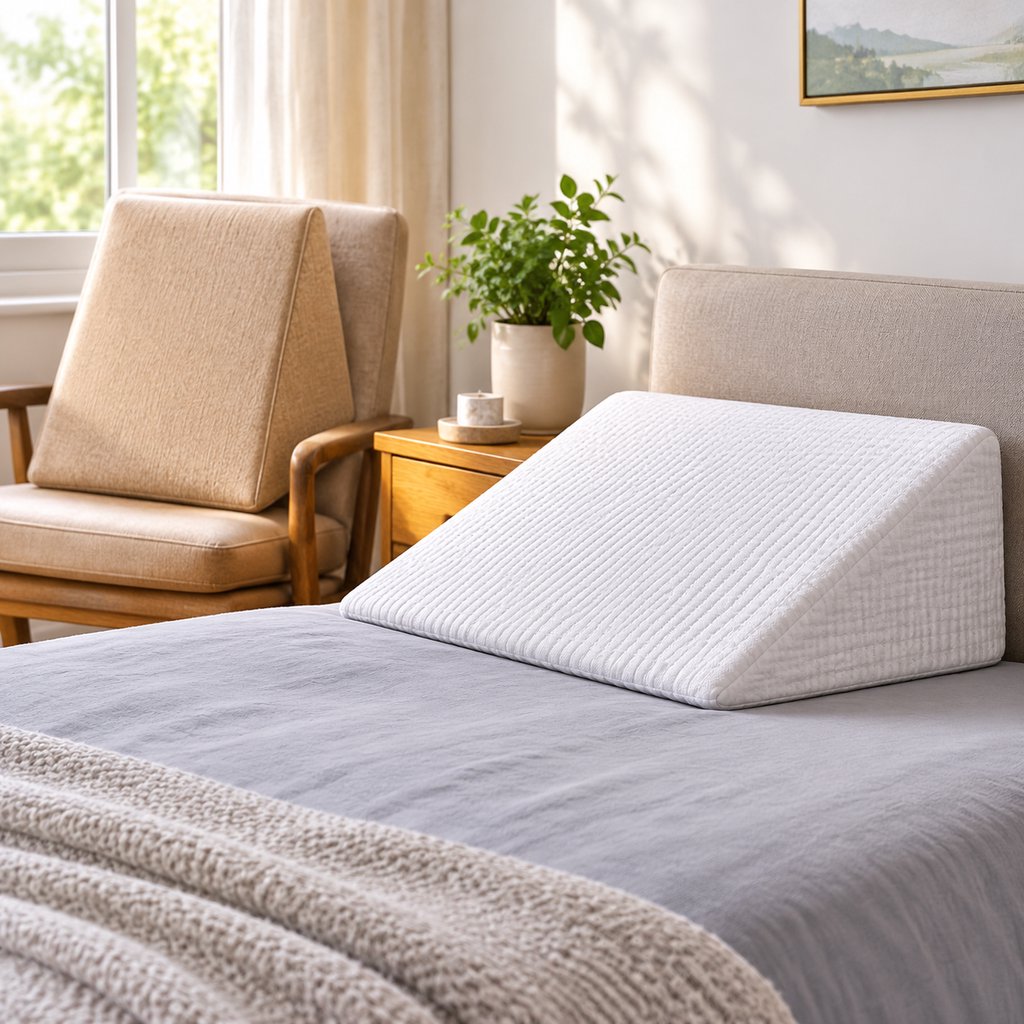
A wedge is gravity turned into a feature. The most familiar version lives in the bedroom — a bed wedge that raises the torso for reflux or breathing comfort, or elevates legs after long days on your feet. But the shape shows up all over the house and the road: sofa arm-gap wedges that fill the yawning gap between armrest and seat cushions, RV dinette seats cut at a slight backward incline because a level seat on a level floor feels like sliding forward, window seat ends that taper into a bay, and tilted bench tops for piano players and guitarists who need their hips level with their hands.
What all of these share: the shape is doing structural work that stuffing cannot fake. A rolled-up blanket under a mattress edge does not hold an angle; a cut foam wedge holds it forever, because the incline is the foam, all the way down.
Angles are easier to order than they look
Most people ordering a wedge do not know the angle in degrees, and they do not need to. The workshop needs three numbers: depth (front to back along the slope), width (side to side), and the height of the tall end. From those, the incline is fully determined — a wedge that is 24 inches deep and 10 inches at the tall end is whatever angle that turns out to be, which is the angle your body already chose when it told you where the old pillow failed. Measure the opening or the intended position, not the flattened old wedge; a foam wedge that has lived under body weight for a year reads lower than it was cut.
One detail worth deciding on purpose: the top edge. A sharp profile is structurally clean but feels like an edge under a sheet; a softened, rounded crown (a few extra dollars of cutting time, nothing more) is what most people actually want to sleep on.
The trapezoid: when a wall is not square
Trapezoid runs appear wherever built construction ignores the right angle: bay window seats whose two sides converge, sectional backs that angle into a corner, bed backrest cushions against a sloped headboard, hearth-side benches that taper with the fireplace wall. A rectangle forced into these openings leaves a triangle of nothing at one end; a trapezoid cut to the actual widths fills it edge to edge.
Measuring is four numbers: the two parallel edges (back edge and front edge of the run) and the depth between them, plus the height or thickness of the cushion itself. The measuring guide covers the edge-to-edge method — the same one used for T-cushions and L-shapes, and the same discipline applies here: measure the opening, work to the quarter inch, write down what the tape says.
The pricing fact worth knowing first
Both shapes are priced from the smallest rectangle they occupy — the bounding box — not from their actual surface area. That is why a 45-degree wedge costs what its full rectangular block would cost: the saw removes the offcut and the offcut cannot be resold. For a small wedge this is trivial money; for a long trapezoid run it is worth knowing that splitting the run into two straighter sections can cost less than one dramatic diagonal — sometimes the two-section look is also easier to clean around. Our cushion pricing guide walks the whole calculation so there are no surprises at quote time.
Comfort spec: support first, edge second
Wedges are support-first cushions: firm high-resilience foam is the rule, because the entire point is that the incline does not compress away — a soft wedge is a slowly deflating accident. Trapezoid backrests run one grade softer, since they lean behind you rather than carry you. Whichever shape you are after, the wedge configurator and trapezoid configurator take those three or four measurements and price the shape instantly — angles, rounded crowns and washable covers included.