
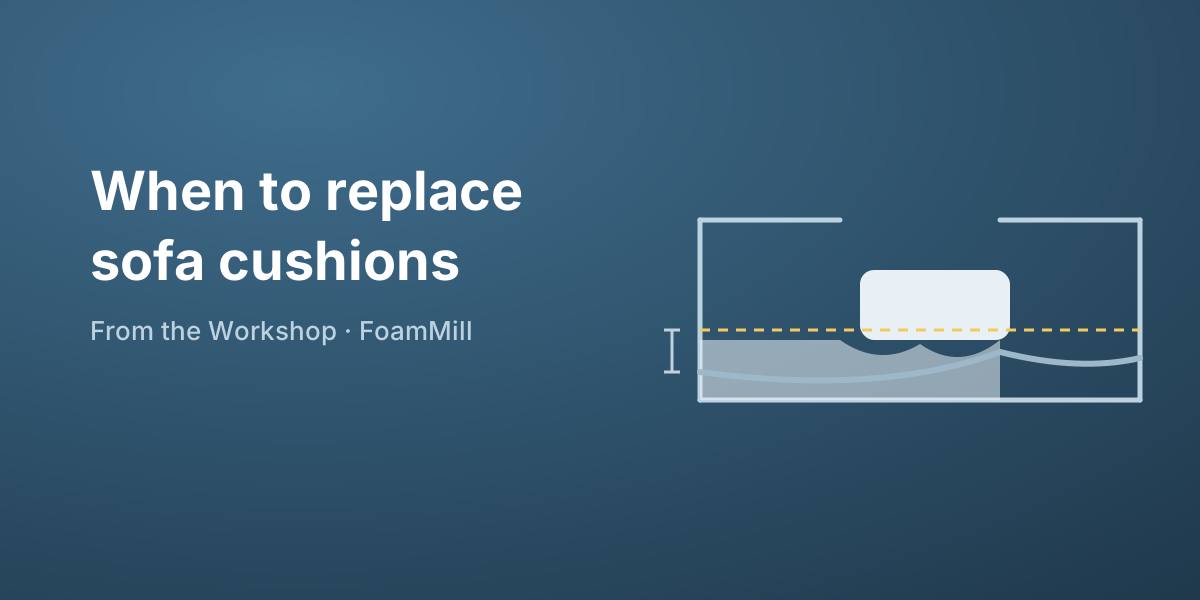
Sofa cushions retire quietly. There is no dramatic failure — they just get flatter, softer and less willing to hold you through a movie, and everyone in the house slowly stops fighting over the good seat. Most people read that as "the sofa is old" and spend thousands on a replacement, when the frame underneath is usually fine and the cushions are a fraction of the cost. Here are the seven signs we tell customers to check before deciding which problem they actually have.
1. The impression doesn't bounce back
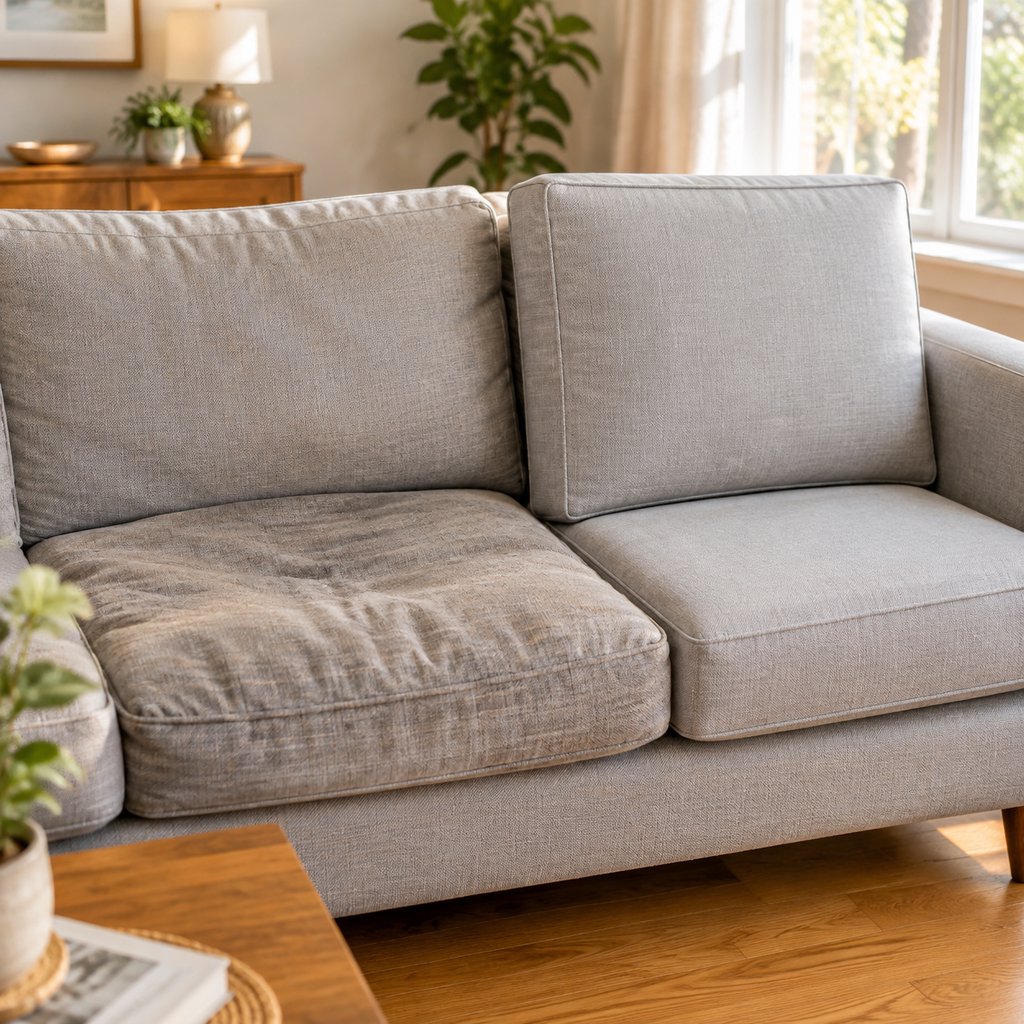
Press your hand into the middle of a seat cushion and lift it. Healthy foam recovers within seconds and leaves no memory of the touch. Fatigued foam holds a shallow bowl where you usually sit — a permanent body impression that's still there in the morning. That dent is compressed cell structure, not dirt or a loose cover, and no amount of fluffing brings the cells back.
2. You sink past a sensible seat height
Sit down properly, feet on the floor. Your knees should be level with or slightly below your hips. If your knees are now above your hips, the cushions have lost the height the frame was designed around — and the sofa's original seat height is printed nowhere, it lives in the foam. Sitting low is not just uncomfortable; it is harder to get up from, which matters more every year.
3. The covers look great and the seat feels flat
Fabric almost always outlives foam. If the upholstery still looks sharp but the seat has gone lifeless, unzip a cover and press the foam inside: if it feels brittle, crumbly at the edges or thinner than an inch of memory of its former self, the foam is done and the cover is reusable. This is the best-case scenario — new foam in the same covers restores the sofa for the cost of the fill alone.
4. Lumps, shifting fill, crumbling corners
Open-cell polyurethane at the end of its life doesn't just sag; it disintegrates. Run a hand over the cushion and feel for hard lumps where foam has packed down, soft voids where it has fallen apart, and check the bottom of the zipper for fine foam crumbs. Cheap, low-density cushions show this at three to five years. Quality high-density foam simply shouldn't — if it does, the grade was never what the sales tag claimed.
5. The musty smell that cleaning doesn't touch
Cushions are sponges with a fabric shell. A spill, a flooded basement room, years of humid summers — moisture that got into the foam and stayed there leaves a smell that professional fabric cleaning cannot reach, because the odor lives in the core, not on the surface. If the cushion smells musty an hour after an afternoon in the sun, the foam has absorbed too much history. Replace it and solve the problem permanently rather than repeatedly.
6. It's past ten years of daily use
There is an honest odometer even when nothing looks wrong. Daily-use seat cushions cut from quality high-density foam hold their feel for roughly seven to ten years; budget cushions give up in three to five; memory foam tops and toppers age faster than base foam. If yours are past a decade of family life, replace them on your schedule with foam you chose — not during a holiday weekend because a guest sat down and disappeared.
7. One cushion became the good seat
When one cushion of a set wears faster than the others (the TV side, the window side, wherever one person always sits), the set is done as a set. Rotating slows it for a while; it never evens out. Replacing the whole set at once keeps seat height, firmness and fabric wear consistent across the sofa — mixing one new cushion between three tired ones is the fastest way to make the whole sofa feel older.
What replacement actually involves
Measure first: the sofa cushion measuring guide covers standard seats and the T- and L-shaped outlines that stock cushions never fit. Choose the feel second — density and firmness are two different decisions, and the foam selection guide walks through grades by application. Keep the covers if they are in good shape; new foam in familiar fabric is the cheapest route to a sofa that feels new again.
When you have the numbers, the custom cushion configurator prices your exact dimensions, thickness and foam grade in seconds — so the fix costs a fraction of a new sofa and actually solves the sitting problem.